Gallery
With thanks to Chris Ure and Bob Mole
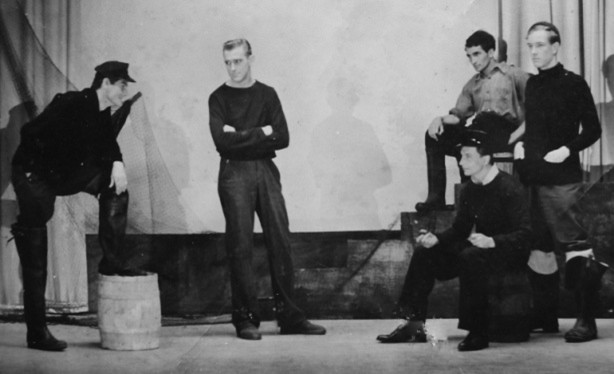
Clive Dunn, sitting on the right of the group in Take It Easy, 1953. Photo: Norman Parker
Supported by
St Edmund’s Hall has stood at the heart of Southwold’s community life for seventy years, but its story begins earlier, with the original church hall built in 1934 for £3,000. The foundation stone was laid by the 3rd Earl of Stradbroke “during a biting snowstorm,” and the official opening later that summer was a grand civic occasion attended by the Lord Mayor of London. Within a year, the Hall was hosting productions such as Aladdin (1935), and by the late 1930s it was a lively venue for church and community events, including the 1937 coronation children’s party.
Tragedy struck in the early hours of 16 May 1941 when a German aircraft dropped bombs across the town. As recorded in the diary of ARP telephonist Thomas King, “The St Edmund’s Hall was destroyed… everywhere alight.” The loss was deeply felt by parishioners who had worked hard to build and support the Hall.
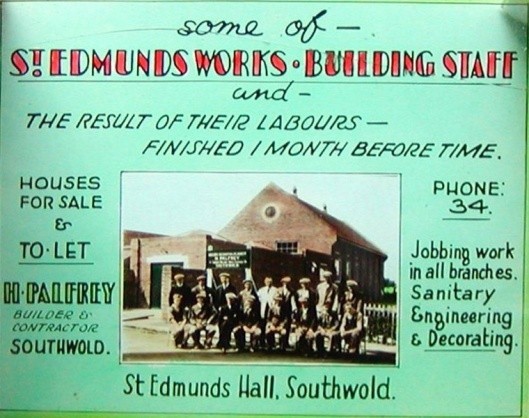
A new Hall was commissioned after the war, built by Hubert Palfrey’s firm and completed a month early despite material shortages. It opened on 7 May 1952, again inaugurated by the Earl of Stradbroke. Architecturally similar to its predecessor but with improvements, it quickly resumed its role as a cultural hub. Theatre returned almost immediately: Christopher Rowan Robinson, who had brought repertory theatre to Southwold in the 1930s, staged Take It Easy in 1952, featuring a young Clive Dunn—later famous as Corporal Jones in Dad’s Army. One review praised Dunn as “lively and likeable… eminently suited to the show.”
The 1950s saw a flourishing of theatre and community activity. Caryl Jenner’s Mobile Theatre brought seven summer seasons, and local authors contributed original playlets on the theme of English queens. The Hall also hosted weddings, Sunday school classes, harvest suppers, and church meetings, reinforcing its identity as the church hall of St Edmund’s.
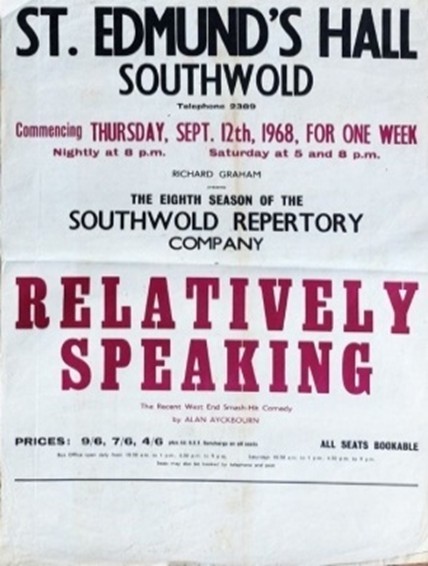
By the 1960s, summer repertory theatre had become a defining feature of Southwold life. Richard Graham’s 1962 season opened with The Amorous Prawn, and by 1968 the Hall hosted Alan Ayckbourn’s breakthrough hit Relatively Speaking. With repertory theatres closing in nearby towns, Southwold became the last Suffolk seaside town to maintain a summer season.
The 1970s brought new creative leadership from Joan Shore, whose seasons nurtured young actors who later achieved national success. But the most enduring era began in 1984 with Jill Freud and Company. After a Christmas show in 1983, Jill Freud launched her first summer season with You’re a Good Man, Charlie Brown. Over more than thirty years, her company became beloved locally and nationally—described by The Observer as “the Rolls Royce of Repertory Theatre.” Jill’s affection for Southwold was deep; she once remarked, “It is timeless, how it was when you were a child.”
Alongside theatre, the Hall continued to serve the church and wider community. Sunday school classes were led by the much loved Elizabeth Bonsey—“Miss Bonsey”—whose memory lives on in the Bonsey Room. The Hall hosted keep fit classes, badminton, rehearsals, meetings, and countless social events. Yet by the late 1980s it had become a financial burden, prompting a major fundraising effort.
In 1991, the STEP project launched a £50,000 campaign to extend and modernise the Hall. Architect John Bennett designed the improvements, and builder Michael Blowers carried out the work while activities continued uninterrupted. Fundraising was imaginative and energetic: garden parties, barn dances, “Buy a Brick,” T shirts, and Dorothy Forster’s famous window box bookstall. Doris Hatfield, chair of STEP, vowed “to put the fun into fundraising.”
A topping out ceremony in 1991 saw the Bishop of St Edmundsbury and Ipswich bless the new roof, and in 1992 the Bishop of Dunwich dedicated the completed extension. By late 1993, the full £50,000 had been raised—an extraordinary community achievement.
Through the 1990s and 2000s, Jill Freud and Company continued to draw enthusiastic audiences, including coach parties from across East Anglia. The Hall also hosted charity events, talks, concerts, and festivals. Even during major works at St Edmund’s Church in 2015 and 2017, the Hall served as a temporary place of worship, demonstrating its adaptability and importance to parish life.
A new chapter began in 2016 with the creation of the Sole Bay Arts Charitable Incorporated Organisation. Under Centre Director Peter Adshead, the Hall was reimagined as the Southwold Arts Centre, with a long term lease from the church enabling investment in facilities and programming. The transformation brought a dynamic year round schedule of theatre, music, talks, comedy, film, and community events.
The Hall is now home to the Southwold Arts Festival, Southwold Literary Festival, Southwold Jazz Club, pantomimes, wildlife talks, and touring theatre companies such as Eastern Angles and fEAST. Its Board of Trustees & General Manager ensure a vibrant and varied programme, continuing the tradition of live performance established in the 1930s.
There is a pleasing symmetry in the fact that today’s Chair of Trustees, Michael Rowan Robinson, is the son of Christopher Rowan Robinson, who first brought repertory theatre to Southwold in 1937 and helped revive it in 1952. The Hall’s story has come full circle.
Across ninety years—through wartime destruction, post war rebuilding, theatrical triumphs, community fundraising, and modern reinvention—St Edmund’s Hall, and now Southwold Theatre, has remained a cherished Southwold landmark. It has hosted weddings, nurtured young actors, supported church life, and provided a home for creativity and community spirit.
With thanks to Chris Ure and Bob Mole